Table of Contents
- How to Choose the Best Rental Car for Roadtrips
- Quick Comparison: Rental Car Types for Road Trips
- The Best Rental Car for Long Distance Driving
- Choosing a Rental Car for a Family Road Trip
- Minivan vs SUV for Road Trip: Which Fits Your Group?
- Road Trip Rental Car Tips: Costs, Policies, and Booking
- Frequently Asked Questions
Last Updated: October 10, 2026
How to Choose the Best Rental Car for Roadtrips
Finding the best rental car for roadtrips starts with one question: what does this specific trip actually require? A solo drive to a nearby state park and a two-week family vacation with luggage for five demand completely different vehicles.
Rental car for roadtrips selection comes down to three variables: distance, passenger count, and cargo. Get those right, and everything else, from fuel stops to parking, gets easier.
Match the Vehicle to Your Trip Type
Trip type determines vehicle class before price ever enters the conversation.
Ask these questions before booking:
- How many people and bags are traveling?
- Is this mostly city driving, highway driving, or a scenic route?
- Will you need towing, hauling, or all-wheel drive?
A compact car handles a solo traveler and a weekend bag without complaint. A family road trip with car seats and a stroller needs something else entirely.
Beyond size, think about the roads. Long highway stretches reward fuel economy and comfortable seats. Rough backroads and winter routes reward ground clearance and traction.
Book your vehicle class based on your worst-case day, not your average day. If one leg of the trip involves four passengers plus luggage, that leg sets your minimum size, even if the rest of the trip is solo driving.
Quick Comparison: Rental Car Types for Road Trips
Each vehicle class trades something for something else. This table summarizes how the main options stack up for long-distance travel.
| Vehicle Type | Best For | Passenger Capacity | Cargo Space | Fuel Economy |
|---|---|---|---|---|
| Compact car | Solo travel, city driving | 4-5 | Limited | Highest |
| Sedan | Two travelers, comfort | 5 | Moderate | High |
| SUV | Families, multi-stop trips | 5-7 | Generous | Moderate |
| Minivan | Large groups, maximum luggage | 7-8 | Maximum | Lower |
| Convertible | Scenic routes, couples | 2-4 | Minimal | Moderate |
The right pick depends on which column matters most to you. Solo travelers rarely need an SUV. Families of six rarely fit comfortably in a sedan.
The Best Rental Car for Long Distance Driving
For most long-distance travel, a midsize sedan is the best rental car for long distance driving. It balances fuel economy, comfort, and trunk space better than any other class.
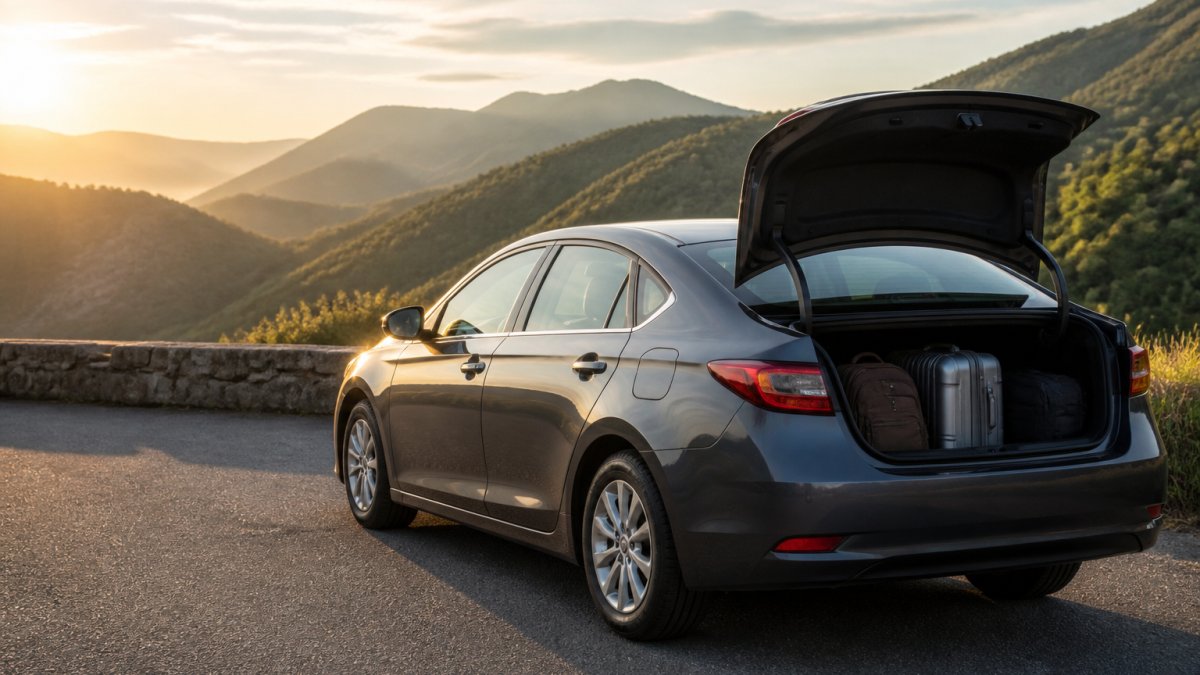
That said, “best” depends on how you define the trip. Two travelers with soft bags will be happiest in a sedan. A group of five with hard-shell luggage will not.
Sedans: Comfort and Fuel Economy for Two Travelers
Sedans win on efficiency. A lighter body and lower profile mean fewer fuel stops across a long driving distance, and the trunk swallows two large suitcases without blocking rear visibility. For couples and solo travelers, this is usually the smartest booking.
The trade-off is flexibility. Sedans sit low, which matters on unpaved roads, and they cap out at five passengers with limited room for a fifth person’s luggage.
SUVs: Space and Versatility for Multi-Stop Itineraries
SUVs trade some fuel economy for vehicle versatility. Higher ground clearance, available all-wheel drive, and a flexible cargo area make them the better choice for adventure travel and routes that mix pavement with gravel.
For a multi-stop itinerary where you are repacking the car every few days, the extra space is worth the mileage hit. Just confirm the specific SUV’s cargo dimensions before booking, since the class covers everything from subcompact crossovers to full-size models.
Booking “an SUV” does not guarantee a specific model. Rental companies group vehicles into classes, and the actual car depends on availability at pickup. If you need a particular size, reserve a class that guarantees the space, or call ahead to confirm.
You Reserve a Class, Not a Model
This is the single most misunderstood part of renting for a road trip.
That matters because classes are broad. A “standard SUV” might be a two-row crossover with modest cargo space or a larger three-row model, both fit the class.
If the assigned vehicle does not fit your needs, you can usually ask to switch within the same class at no extra cost, subject to availability.
Pickup and Return Inspection Checklist
A five-minute inspection at pickup prevents a damage dispute at return. Do this every time:
- Walk the full exterior in good light and photograph any existing scratches, dents, or cracked glass before you leave.
- Check the tires, tread depth, sidewall damage, and that the spare or inflation kit is present. A road trip is the worst time to discover a bad tire.
- Confirm safety and convenience features, headlights, turn signals, brakes, wipers, and the spare or jack. Test the air conditioning and charging ports.
- Note the fuel level and the fuel policy (full-to-full, prepaid, or same-level). Photograph the gauge.
- Check the odometer and confirm the mileage allowance matches your booking.
- Verify the equipment you reserved, child seat, roof rack, or transponder, is actually installed.
At return, refuel to the required level, keep your fuel receipt, photograph the gauge and odometer, and get a written or emailed confirmation that the vehicle was accepted. That record is your protection if a damage claim appears later.
Photograph the car from all four corners plus the roof and wheels before you drive away. Time-stamped photos are the simplest defense against a damage dispute.
Choosing a Rental Car for a Family Road Trip
A rental car for a family road trip lives or dies on passenger capacity and legroom. Three rows of seating sound generous until you load car seats, a cooler, and a week of luggage into the same space.
Families should prioritize:
- Seating configuration: Second-row captain’s chairs versus a bench changes how easily kids get in and out.
- Legroom in the third row: Adults and older kids need usable space, not a cramped afterthought.
- Cargo space behind the third row: This is where most families get surprised.
Passenger Capacity, Legroom, and Child Seats
Child seats are the detail families most often overlook. Reserve them with your booking, and confirm the seat type matches your child’s age and weight.
Legroom matters more than headroom on long trips. Check the third-row legroom specifically, because many three-row SUVs offer generous space up front and almost none in the back. If your group includes adults in the third row, a minivan usually wins on comfort.
Minivan vs SUV for Road Trip: Which Fits Your Group?
The minivan vs SUV for road trip decision comes down to one thing: how much stuff are you carrying? Minivans offer more usable cargo space and easier access to the third row.
Here is how to decide:
- Choose a minivan for maximum luggage capacity, sliding doors that make loading kids easier, and the lowest load floor in the class.
- Choose an SUV if your route includes rough roads, winter conditions, or you simply prefer the higher driving position.
For a family of five or more with a full luggage load, the minivan is almost always the more practical pick. For a smaller group that wants capability on mixed terrain, the SUV earns its place.
Groups of five or more traveling with a full load of luggage, plus anyone who values easy third-row access over ground clearance.
Road Trip Rental Car Tips: Costs, Policies, and Booking
Smart road trip rental car tips save money before the engine ever starts. The daily rental rate is only part of the total trip cost, and the extras are where budgets quietly stretch. Here is how those fees actually work.
Build a Total Trip Cost Estimate
A daily rate comparison tells you almost nothing about which vehicle is cheapest for your trip. Build the full number instead:
- Base rental, daily rate multiplied by the number of rental days, not travel days. A Saturday-to-Saturday booking is seven days even if you only drive five.
- Mileage, confirm whether your rate includes unlimited miles or caps them. Many budget and one-way rates impose a daily or total mileage allowance, then charge a per-mile overage. On a 1,500-mile road trip, a capped rate can erase the savings of a lower daily price.
- Insurance and protection products, the loss damage waiver, supplemental liability, and personal accident coverage are typically sold separately and priced per day. A per-day add-on multiplied by a two-week trip is often the single largest line item after the base rate.
- Fuel, estimate total miles divided by the vehicle’s combined MPG, multiplied by the current average price per gallon. A larger SUV can cost meaningfully more in fuel over 1,500 miles than a sedan, which is why the cheapest daily rate is rarely the cheapest trip.
- Tolls and parking, many rental companies offer an electronic toll transponder for a convenience fee plus the tolls themselves; paying cash or using your own transponder can avoid the markup.
- One-way drop-off, returning the car to a different location than you picked it up usually triggers a drop fee, and the amount varies by distance and demand. Confirm it at booking, not at the counter.
Add those six numbers for each vehicle class you are considering. The class with the lowest daily rate frequently loses once mileage caps and fuel are included.
Rental Policies That Change Road-Trip Plans
These are the rules that quietly derail itineraries:
- Mileage caps. Unlimited-mileage rates are common for local rentals but less so for one-way and specialty vehicles. Read the mileage term before you book.
- One-way rentals. Dropping in a different city or state is usually allowed between company locations, but the fee and availability vary. Book early, one-way inventory is limited.
- Cross-border travel. Taking a rental across state lines is normally fine, but crossing into another country requires written permission and often additional insurance. Do not assume it is allowed.
A low daily rate with a mileage cap and a young-driver fee can cost more than a higher unlimited-mileage rate. Price the whole trip, not the sticker.
Insurance: Decide Before the Counter
Your personal auto policy or credit card may already cover part of a rental, so check both before paying for the rental company’s coverage. Understand the deductible and what is excluded, because incidentals add up fast after even a minor incident.
The cheapest daily rate rarely produces the cheapest trip. Add mileage terms, insurance, fuel, tolls, and any one-way fee to every option before you compare, and the real winner often changes.
Booking Habits That Prevent Problems
- Reserve the vehicle class, not a specific model, see the pickup checklist below.
- Confirm the fuel policy so you return the car correctly.
- Note the drop-off location and any one-way restrictions up front.
For guidance on driver requirements and insurance basics, the Insurance Information Institute’s auto insurance resources explains how personal coverage often extends to rentals. If your trip crosses state lines, the U.S. Department of Transportation publishes traveler resources worth checking before you go. And for general road-trip planning, AAA’s travel resources covers route and safety guidance.
Frequently Asked Questions
What should I look for when renting a car for a road trip?
Focus on four things: fuel economy, cargo space, passenger capacity, and comfort for long hours behind the wheel. Check the daily rental rate and any additional fees before booking, and confirm whether your insurance coverage extends to the rental. For a multi-stop itinerary, prioritize luggage capacity and legroom. A compact car works for solo travel, while an SUV or minivan suits families. Always inspect the vehicle at pickup and note existing damage to avoid incidentals at drop-off.
Is a minivan a better choice for a family road trip than an SUV?
For most families, a minivan wins on space and access. Minivans typically offer more cargo space behind the third row, lower step-in height for kids, and sliding doors that are easier in tight parking. SUVs often provide more ground clearance and towing capacity, which matters if your route includes rough terrain or you are hauling a trailer. If your trip is mostly highway driving with frequent stops, the minivan’s layout usually makes loading and unloading simpler.
Is a sedan or SUV better for a long road trip?
A sedan is usually the better pick for one or two travelers covering long distances. It delivers higher fuel economy, a lower daily rental rate, and a quieter ride on the highway, which reduces fatigue over a long drive. Choose an SUV when you need extra cargo space, passenger capacity, or all-wheel drive for winter conditions. Match the vehicle to your group size and luggage, not to the longest possible list of features.
Should I rent a hybrid or EV for a road trip?
A hybrid is a low-risk choice for long-distance travel: you get better gas mileage without depending on charging infrastructure. A full EV can work well if your route has reliable fast-charging stops and you plan each leg around them. Before booking an EV, map charging stations along your route, confirm the vehicle’s real-world range, and check whether your pickup location provides a fully charged vehicle. For remote scenic routes with sparse chargers, a hybrid or gas vehicle is the safer option.
A great road trip depends on a vehicle that fits your group, your route, and your budget, without surprises at the counter. That is exactly what 1st Choice Rentals delivers: a streamlined rental process, dependable vehicles, and a team that answers your questions before and during your trip. Whether you need a compact car for a solo drive or a larger vehicle for a family adventure, we make the choice simple. Rent today with 1st Choice Rentals and start your trip with the right car.